
Opening a restaurant is exciting. You have a concept you believe in, a menu you are passionate about, and a vision for creating an experience customers will love.
But running a successful restaurant requires much more than great food.
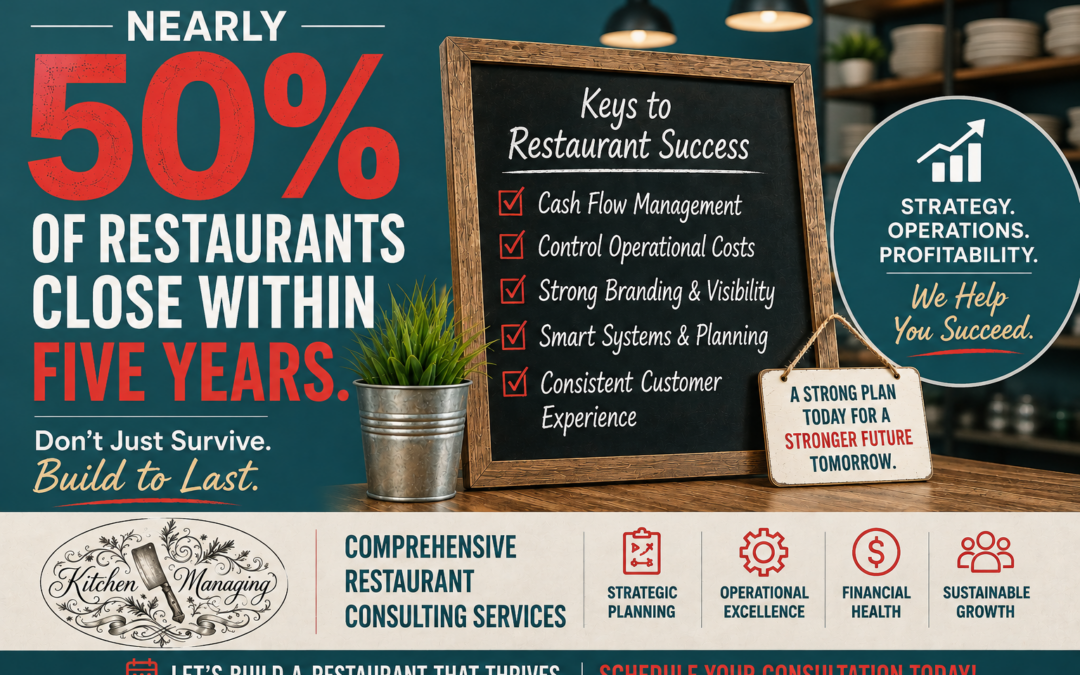
The restaurant industry operates on tight margins, rising costs, staffing challenges, and constant pressure to attract and retain customers. According to the information summarized above, roughly half of restaurants close within five years, while approximately 17% fail during their first year. These numbers highlight an important reality: restaurant success requires careful planning, disciplined management, and the ability to identify problems before they become crises.
That is where Kitchen Managing’s Comprehensive Restaurant Consulting Services can make a difference.
Why Do Restaurants Struggle?
Restaurant closures rarely come down to one single problem. More often, several challenges come together and gradually put pressure on profitability and operations.
1. Cash Flow Problems
A restaurant can be busy and still struggle financially.
Managing payroll, food purchases, rent, utilities, equipment repairs, insurance, taxes, and other expenses requires constant attention. Poor cash management can leave an otherwise promising restaurant without enough working capital to handle unexpected expenses or seasonal slowdowns.
Strong cash-flow management means knowing where your money is going, understanding your costs, planning ahead, and making informed decisions before cash becomes a problem.
Kitchen Managing can help restaurant owners examine financial and operational practices to identify opportunities to improve efficiency, control expenses, and protect profitability.
2. Rising Operational Costs
Labor, ingredients, rent, utilities, supplies, and other operating expenses can quickly eat into restaurant profits.
Even small increases in costs can have a meaningful impact when profit margins are already narrow. Restaurants need to continually evaluate food costs, labor costs, purchasing practices, portion control, scheduling, waste, and pricing.
Successful restaurant management is not simply about cutting costs. It’s about controlling costs without sacrificing quality, service, or the customer experience.
3. Location, Visibility, and Branding
A great restaurant still needs customers to find it.
Location, signage, online presence, reputation, branding, marketing, and customer engagement all influence whether people walk through the door or place an order.
If a restaurant has inconsistent branding or weak visibility, it may be losing customers before they ever have the opportunity to experience the food.
A strong restaurant strategy should look at the entire customer journey—from discovering the business online to visiting the restaurant and becoming a repeat customer.
Restaurant Success Requires More Than Great Food
One of the biggest misconceptions in the restaurant business is that excellent food alone guarantees success.
Food matters tremendously, but successful restaurants also depend on:
- Effective operations
- Financial discipline
- Strategic menu planning
- Proper staffing and scheduling
- Consistent customer service
- Inventory and purchasing controls
- Marketing and branding
- Food-cost and labor-cost management
- Leadership and accountability
When these areas work together, a restaurant is in a much stronger position to remain profitable and sustainable.
How Comprehensive Restaurant Consulting Can Help
At Kitchen Managing, restaurant consulting is about looking at the business as a whole—not simply addressing one problem at a time.
A comprehensive consulting approach can help identify operational weaknesses, uncover unnecessary expenses, improve systems, and create practical strategies for sustainable growth.
Whether you are opening a new restaurant, struggling with profitability, trying to improve operations, or looking to take an established restaurant to the next level, professional guidance can provide an objective perspective.
Kitchen Managing’s consulting services can help restaurant owners evaluate areas such as:
- Operational efficiency
- Food and labor costs
- Menu performance and pricing
- Inventory management
- Purchasing and vendor practices
- Staffing and scheduling
- Customer service
- Marketing and branding
- Cash-flow management
- Business planning and growth strategies
Don’t Wait Until Your Restaurant Is in Trouble
One of the most important lessons restaurant owners can take from industry survival statistics is that proactive management matters.
Waiting until cash flow becomes critical, food costs get out of control, employees are constantly leaving, or customer traffic declines can make problems much more difficult—and expensive—to solve.
Consulting isn’t only for failing restaurants.
It can also be valuable for restaurants that want to:
- Increase profitability
- Improve efficiency
- Reduce waste
- Strengthen operations
- Create better systems
- Improve the customer experience
- Prepare for growth
The goal is to identify opportunities and potential problems early so you can make informed decisions with greater confidence.
Build a Restaurant Designed to Last
The restaurant industry can be incredibly rewarding, but success doesn’t happen by accident. It takes thoughtful planning, consistent management, financial awareness, and a willingness to continuously improve.
With nearly half of restaurants reportedly closing within five years, restaurant owners need more than passion and a great menu. They need a business strategy that supports long-term sustainability.
Kitchen Managing’s Comprehensive Restaurant Consulting Services can help you take a closer look at your restaurant, identify areas for improvement, and develop practical strategies designed to strengthen your business.
Ready to Take a Closer Look at Your Restaurant?
Don’t wait for a small problem to become a major one.
Contact Kitchen Managing today to schedule a restaurant consultation.
Let’s evaluate your operation, uncover opportunities for improvement, and create a practical plan to help your restaurant operate more efficiently and build toward long-term success.
Your restaurant’s future is too important to leave to chance.
Note: The survival statistics referenced in this article are based on the information provided and should be verified against the original Bureau of Labor Statistics and industry sources before publication as authoritative statistics.